Guest arrival
Map the route to unit entry: call point, common entrance, credential delivery and the fallback path.

A serviced-stay project has four linked decisions: arrival, unit entry, service access and checkout. Establish the operating sequence, physical openings and available infrastructure before selecting equipment or confirming interfaces.
The access plan must join the booking event, guest route, service work and checkout closure.
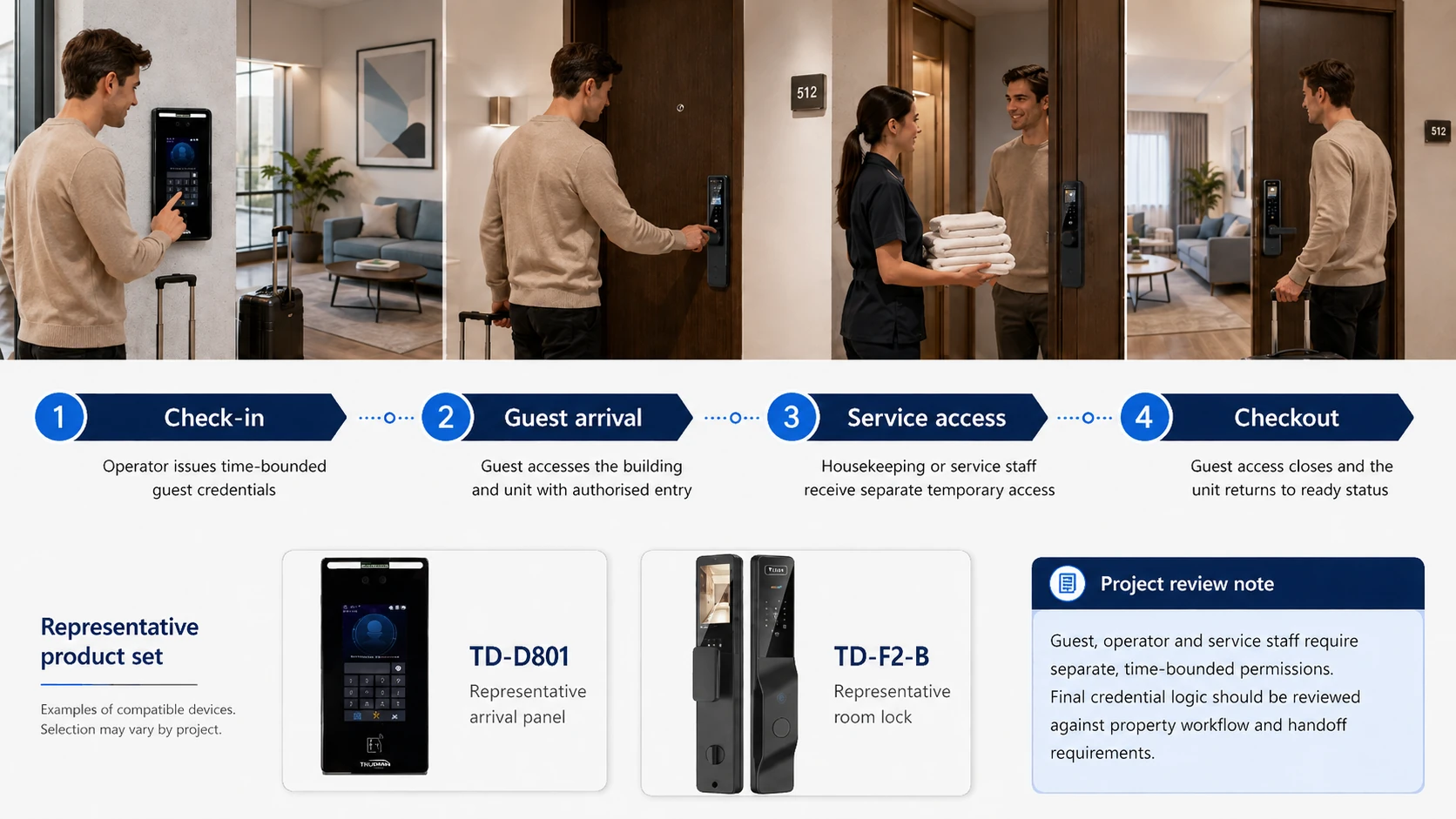
Short stays compress guest movement, operating decisions and service work into the same physical environment. The access plan should separate authority by role and time window, not simply by door.
Map the route to unit entry: call point, common entrance, credential delivery and the fallback path.
Assign authority to issue, amend and close credentials; define the information needed for exceptions, handovers and checkout.
Separate housekeeping, maintenance and emergency activity by access area, approved time and accountable operator.
When booking, property-management or other operating data matters, identify the event, its owner and how it changes access. Confirm the handoff before models or interfaces are selected.
A written brief identifying the event, credential route, role permissions and expected closure condition for the agreed scope.
The review converts operations into a defined scope: events, changes of authority and physical openings. Interface options and equipment suitability are then assessed against the project inputs.
Identify the stay event, unit allocation and source information that start the workflow.
Compare mobile, PIN and card routes against guest support, recovery access and property procedures.
Set the areas, time windows and authorisation for housekeeping, maintenance and other service staff.
Specify when guest access ends, how outstanding staff access is treated and which records remain.
A guest-room door, common entrance and service area require different credential, calling and permission rules. Assess each opening before selecting models.
Define credential preference, recovery access, door conditions and the support available to the guest or operator.
Review smart locksAssess lobby, gate, shared entrance and visitor-calling requirements against the arrival and after-hours process.
Review video intercomSeparate housekeeping, maintenance, storage and controlled service areas into defined permission groups.
Review access controlStart with confirmed operating facts, not a default configuration. They determine which openings, credentials, equipment and documents require review.
Share the property type, unit count, controlled openings, stay model, destination and available drawings. These inputs structure the equipment and documentation review for the stated project scope.
State the property type, unit count, controlled openings, stay model, operating roles and available drawings or system information. These inputs establish what needs to be reviewed before equipment is selected.
Review it when a booking, guest, credential or checkout event informs the access workflow. Identify the event, its owner and the proposed handoff before confirming interfaces or equipment.
Assess mobile, PIN and card routes against the arrival process, guest support, fallback access and property procedures. The right route is the one the operator can support at each stage of the stay.
Define the access areas, approved time windows and accountable roles for housekeeping, maintenance and other service staff. Record how exceptions and access closure are handled.
The required documents depend on the selected model, installation context and destination market. Review available drawings, project requirements and relevant destination-market conditions before quotation or procurement.