
TD-F2-B uses a semiconductor fingerprint sensor and lists 297 general-user sets, 50 facial-recognition sets and Tuya App management. Confirm the supplied configuration and destination documentation before quotation. Private-label programmes start at 500 units.
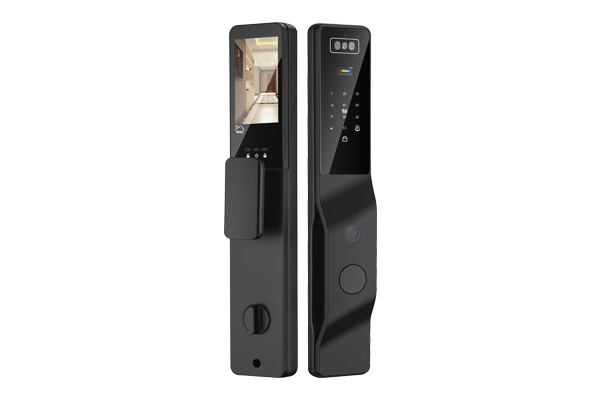
Use this view to check the hardware, credential mix and emergency route before confirming door preparation and lock-body selection.
The TD-F2-B data sheet lists these access methods and the emergency route.
| Unlock methods | Fingerprint, IC card, password, face, palm vein, mechanical key, combination verification, Tuya App and temporary password |
| User capacity | 3 administrators / 297 general users / 50 facial-recognition sets |
| Dimensions | Front panel: 425 × 70 mm; rear panel: 413 × 76 × 73 mm |
| Material | Engraved aluminum with a tempered-glass panel |
| Emergency cylinder | Grade C lock cylinder |
| Battery | 4,200 mAh lithium battery |
| Emergency power | 5 V Type-C USB port |
| Fingerprint recognition | Semiconductor sensor; 0.5 seconds |
| Camera and display | 2 MP night-vision camera; 4.5-inch IPS screen |
| Operating temperature | -25°C to +70°C |
| Static / dynamic current | 120 μA / 4 A |
| Color | Black |
Match the required certification, language and installation evidence to the exact model, firmware and destination before quotation.
EN 12209 Grade 3 documentation and any DoC template are confirmed by model. Check current KfW or other funding rules separately for the supplied configuration and project.
View all certificationsSASO or other destination documents, Arabic-language requirements and temperature evidence are confirmed by model and KSA project. Review the installation conditions before specifying outdoor hardware.
Saudi Arabia detailsFCC Part 15 for Wi-Fi and Bluetooth. ANSI/BHMA Grade 2 mechanical compliance for US residential and light-commercial applications including multifamily MDU.
US market detailsConfirm branding, packaging, app route and destination documentation against the TD-F2-B configuration before quotation. Standard supply is 200 units; OEM/private label starts at 500; ODM starts at 1,000.
Semiconductor (capacitive) sensors read electrical ridge/valley differences. Spoof-resistance and wet/dry performance depend on the exact sensor, firmware and test conditions, so request model evidence before specification. The TD-F2-B uses a semiconductor sensor on the documented configuration.
The TD-F2-B data sheet lists 3 administrator sets, 297 general-user sets and 50 facial-recognition sets. It supports fingerprint, IC card, password, face, palm vein, mechanical key, Tuya App and temporary password access. Confirm the required enrolment mix and app workflow on a sample before supply.
The TD-F2-B uses a 4,200 mAh lithium battery. Runtime and low-battery thresholds depend on the supplied configuration and should be confirmed from the final data sheet. The documented emergency route uses the external power contact when the internal battery is depleted.
CE/RED, CE/LVD, EN 12209 and RoHS documents are reviewed by model and destination. Request the Declaration of Conformity, test reports and any DoC template for the supplied configuration; an importer applying its own brand should confirm its legal responsibilities under the current EU rules.
The published TD-F2-B configuration uses Wi-Fi and the Tuya app route. Do not assume Wiegand, OSDP or another access-control interface; name the required controller, firmware and workflow so a supported connection can be confirmed before supply.
Privacy handling for the TD-F2-B depends on the model, app route and destination. Confirm where biometric templates and access logs are stored, how deletion or export is handled, which fallback credentials are offered and who operates the data. European workplace projects should complete their own DPIA and legal-basis review before deployment; request the relevant model and data-flow documents in writing.
OEM/private-label programmes start at 500 units and can include logo application, custom packaging, white-label app configuration, housing color and selected firmware requirements. Documentation and certification requirements are confirmed by product and target market before quotation.