
Use the TD-D801 for MDU or commercial entrances that need a SIP 2.0 door panel. The PBX, ONVIF/NVR path, firmware, credentials and destination requirements must be checked against the proposed configuration before quotation.
Use SIP 2.0 when a door station must register to an existing PBX or share a call plan across multiple entrances. The PBX, network and lock interface set the final design.
Register the TD-D801 as a SIP endpoint on the named PBX. Verify transport, codecs, DTMF, authentication and door-release behaviour against the server configuration.
The specification lists up to 9,999 apartment extensions in a SIP server design. Final capacity depends on the server, directory, entrance count and call-flow rules across towers, floors and mixed-use units.
The TD-D801 can be reviewed for connection with Asterisk, 3CX or another PBX. Map the call flow to the target server and check licensing, mobile-answering and simultaneous-ringing rules before approval.
PoE 802.3af carries power and data when the switch or injector has sufficient budget. Check the cable route, port allocation, VLAN, firewall and local backup-power requirement in the site design.
The panel can be reviewed for an ONVIF connection with a named NVR/VMS. Confirm the required stream, codec and event set, then test discovery, authentication, video, audio and relay events on the target firmware.
SIP over TLS and SRTP are conditional on the selected firmware and PBX. Define certificates, cipher policy, NAT handling and logging requirements before commissioning.
Before quotation, record the items below against the selected model, firmware and target infrastructure.
Record SIP 2.0, transport, codecs, registration limits, DTMF and inbound/outbound call tests for Asterisk, 3CX or the named PBX.
Record the ONVIF request, RTSP streams, firmware and target NVR/VMS. Test discovery, authentication, video, audio, events and door-release workflow.
Check the 802.3af power budget, cable route, IP plan, firewall and NAT. VLAN deployment is possible when the site policy and switch configuration permit it.
For standard supply, OEM/private label or ODM scope, request the model-specific datasheet, configuration guide, sample terms, change-control record, certifications and acceptance checklist.
Use the SIP and ONVIF selection guide for product choice, the multi-tenant planning guide for entrances and units, the ONVIF connection checklist for NVR/VMS testing and the video intercom projects FAQ for buyer questions.
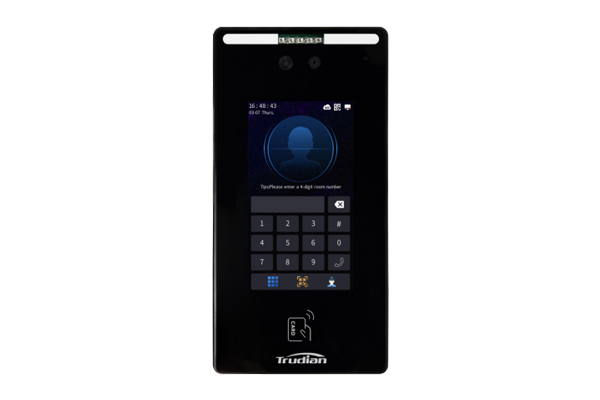
The TD-D801 is a full-IP SIP 2.0 door panel with PoE, IK08 housing and optional Face ID and RFID access. Confirm the option set in the quotation.
| Unlocking | Facial recognition, password, card, QR code, indoor monitor and cloud platform remote control |
| Appearance size | 258 × 135 × 22.5 mm |
| Material | Luxurious pure aluminium and tempered glass |
| Screen display | 8-inch LCD capacitive touch screen |
| Screen resolution | 800 × 1280 |
| Camera | 2 million pixels |
| Operating system | Linux |
| CPU | ARM Cortex A7, 4 cores |
| Random access memory | 1G |
| Flash | 8G |
| Facial recognition | Up to 20,000 faces; liveness detection |
| Network mode | TCP/IP |
| Reading distance | 0-6 cm |
| Card capacity | Unlimited; read and write sectors |
| Power supply | DC 12V |
| Operating current | 550 mA |
| Standby current | 290 mA |
| Working temperature | -40°C to +70°C |
| Working humidity | 10%-90% |
| Installation method | Wall-mounted or embedded |
| Wall buried size | 246.6 × 117.2 × 13.5 mm |
| IP rating | IP65 |
| Functions | Video call, camera surveillance, elevator control and smart advertising playback |
| Visitor message | Photo and video |
| Alarm | Automatic detection of door opening and closing status |
| Remote online upgrade | Supported |
| Trudian Community Management Center Platform | Supported |
| SIP protocol | SIP 2.0 (RFC 3261) |
| Audio codec | G.711 PCMU/PCMA, G.722 and G.729 |
| Video codec | H.265 / H.264 |
| PoE | IEEE 802.3af Class 3; up to 15.4 W |
| ONVIF / RTSP | Connection available for review by model and firmware |
| Wiegand | 26-bit and 34-bit output |
| RS-485 | Multi-drop bus for elevator-control integration |
| Door release | Dry relay; 12V/1A output |
| SIP server capacity | Up to 9,999 apartment extensions in a SIP server design |
The patterns below are starting points, not certification statements. Bench-test the named PBX, firmware and call flow before issuing a purchase order.
[d801-lobby]
type=friend
host=dynamic
secret=YourPassword
context=intercom
dtmfmode=rfc2833
nat=force_rport,comedia
qualify=yes
codec=ulaw,alaw,g722
The panel can be reviewed for an ONVIF or RTSP connection to a named NVR/VMS. Confirm the model, firmware, codec and event requirements, then test discovery, authentication, streams and relay behaviour during site acceptance.
rtsp://[device-ip]/stream0
rtsp://[device-ip]/stream1
http://[device-ip]/onvif/device_service
The TD-D801 provides Wiegand and RS-485 outputs for third-party access-control panels. Check voltage, card format, bus addressing and relay behaviour against the existing controller before installation.
| Format | 26-bit & 34-bit |
| Voltage level | 5V DC TTL |
| Max cable length | 150 m (26-bit) / 100 m (34-bit) |
| Trigger | Card tap / PIN entry / Face ID |
| Panels for review | named Wiegand access-control panels, subject to interface test |
Use these bands to scope the server, directory, entrance count and call-flow rules. They are planning ranges, not a single-device capacity guarantee.
Send the model, quantity, entrance count and target PBX/NVR for an itemized quotation. Include OEM, private-label or ODM scope when it applies.
The TD-D801 can be reviewed for connection with Asterisk, 3CX or another PBX. Verify registration, transport, codecs, DTMF, authentication and door-release behaviour on the named server and firmware before approval.
The specification lists up to 9,999 apartment extensions in a SIP server design, with a unique SIP URI for each unit. This is not a single-panel limit; final capacity depends on the server, directory, entrance count and call-flow requirements.
The TD-D801 can be reviewed for an ONVIF connection with the named NVR or VMS. Confirm the model, firmware, stream, codec and event requirements, then test discovery, authentication, video, audio, events and relay behaviour.
The interface is specified as 26-bit and 34-bit Wiegand at 5V DC TTL. Stated cable limits are 150 m for 26-bit and 100 m for 34-bit. Confirm the controller electrical level, card format and cable route before installation; RS-485 is a separate interface for supported elevator-control designs.
Define the storage model, data region, retention period, controller/processor roles, DPA, resident notices or consent workflow and access logging. On-premise NVR and cloud designs have different responsibilities; record the selected model in the project documents.
IEEE 802.3af Class 3, up to 15.4 W, is specified over Cat5e or Cat6. Typical TD-D801 draw is approximately 8–10 W. Select the switch or injector by power budget, class and cable run, then verify the final values against the model datasheet.
Resident smartphone calling is possible when the selected SIP server and app support push delivery, live video and the approved door-release command. Confirm the app, network path and remote-release behaviour in the acceptance test; latency depends on the site and mobile networks.
A smart-lock SIP system needs more than call signalling: identify the receiving endpoint, authorisation source and approved command interface. Smart-lock SIP connection is confirmed only for the named intercom, lock, firmware and control route. The same rule applies to video-intercom SIP connection in a multi-door project. A video-intercom SIP system still requires a topology, account plan and acceptance test for the named devices.